Tuesday, September 24, 2013

0 It's JUST a Preliminary....But Seriously Folks, Every Vote Counts - Don't Be Silent Now


Even more than the November 5th election date, today's preliminary election for Boston Mayor and city council is when everyone should get out and vote. It is really the only time when we as voters have the strongest ability to truly voice our choice for whom we want to represent us. No matter who you are voting for, I say this: GET OUT TO VOTE! After tomorrow, the outcome could effectively eliminate your real choice as an option, but at least you will know that you did get to vote your true choice of candidates first - and that is something you can be proud of.

For the first time in 20 years, the Mayor's race is a wide-open field with no incumbent to defeat, and the same is true for many of our city council seats. In January we will not only have a new Mayor, but almost a completely new city council in Boston, which quite frankly is a bit unnerving. These factors, and the important issues that have been at the forefront of all of the candidate forums, house parties, meet and greets, at dinner tables, school yards, spontaneous gatherings, on the phones and at the doors, show that our city is truly at a critical turning point in history. The results of this preliminary election could potentially change Boston in so many ways. 

There are any number of issues which people care about: public safety, transportation, casinos, city services, of course - education and many more. Whatever your main area of concern is, the issue that motivates you, please make sure to make it to the polls to vote. 

Despite what the mainstream media and campaign machines are saying via articles and polls, my experience watching elections and especially as someone who has actually personally talked to thousands of Bostonians through my own volunteer work before this election madness and since, as a volunteer and adviser for several of the candidates, is that the predictions are not reflecting the candidates Boston voters are really planning on voting for and actually supporting. 

The polls that have been done during this latest election blitz have been designed to get the results the pundits want. Of course, this is all done for a purpose: to rig the election in favor of those chosen by many of the same groups and companies that led us to where we are in America today: the 1% who reap the most profit while our citizens struggle daily, entire public school districts are closing down, and families are homeless. 

These same "king makers" count on the fact that if the polling reflects a poor prediction for a particular candidate, then that candidate's regular support base will either stay home or instead vote for one of the other candidates who seemingly have a better chance of winning the election. After all, if the polls say that the one vote you cast won't matter, why cast it? Guess what? The backers, the interpreters of the poll data, the pundits and especially the candidates' who are the darlings of these aforementioned folks, count on that as it has been an effective tool in the past. 

Of course, there is also the misleading campaign literature and advertisements by candidates, which when people compare them with their actual professional experience and record of achievements, amounts to nothing more than the proverbial house of cards. Add in the campaign workers who have been imported not just from the suburbs, but from all over the country, who tout certain candidate's misrepresentations with a smile, and instead of a true picture of some candidates, you can almost see the actual players behind them - those who they will be beholden to once in office - those who will try to make our city their newest source of profit one way or another.

Well, I am here to tell you a secret the alleged political experts are terrified will get out: YOUR ONE vote counts MORE than any poll conducted by those who would steal your voice and choice from you. Each one of us who decide to get out and vote for OUR chosen candidate, despite what the polls might say about their chances, disproves the predictions and add to the likelihood that the results of our election will more closely resemble the collective voice of BOSTON residents - not those paid to influence them or those who will tear our city apart without a second thought. 

So, please, don't let the polls, misrepresented records and supposed achievements spouted via campaign literature and ads, the endorsements by mainstream media, corporate backed groups, or the outright lies of certain ordained "front-runners" fool you. Don't allow the people and groups behind the polls decide for you: instead, go with what YOU know from your own research and those of us who are living here in Boston with you. Let it be OUR voices that are heard at the end of the night. 

As Big Papi recently said, unfortunately due to a horrendous and cowardly act that has already changed our beautiful city: "This is OUR city. And nobody going to dictate our freedom." 

Don't let others dictate what our city will become. Show those who would profit off our city while bankrupting our future that Boston voters understand their rights and what true freedom really is.

Have questions or just want to see what I am working on? Feel free to email me at karen.kastmcbride@gmail.com or follow me via Twitter: @RebelInBoston.

Wednesday, June 26, 2013

0 The Facts About Charter Schools That No One Tells You

There is a lot of talk about charter schools and raising the cap to allow more of them to open in Massachusetts. Boston is ground zero for the charter school "education reform" conglomerates, individuals and organizations, like the newly formed "Boston Forward" group, which are greedily counting the millions of dollars to be made off of our students if this is allowed to happen. This situation has led to a lot of questionable push-poll results being passed off by our larger media news sources as charter school "facts" which are further confusing the argument for the public even after those "facts" have been proven incorrect or unsubstantiated. 

Add in a Mayoral race filled with many candidates, most of whom are willing to sell out our students for campaign funds by spouting the "raise the cap" chant (only three are against raising the charter school cap), and you may understand one of the reasons why education has become a major focus of the elections in Boston. If you think the Mayoral and City Council races aren't a big deal right now, you may really want to start paying attention, because they are!   

Other than knowing that charter schools are an "alternative" to "regular public schools" most people do not fully understand: how they are funded, the student populations served, their actual graduation rates and the differences between them except for their separate "lottery" admissions procedures. This became more obvious to me through a number of conversations in several venues so my inner-educator-activist kicked in to write this article that I hope will help families and the broader community understand why so many people, education advocates and organizations that care about educating all of our students are saying "don't lift the cap" on something that, in theory, sounds good.

Funding:
Many people think charter schools are privately funded, which is false. The money that pays for students to attend a charter school comes out of the sending district's budget. Here in Boston, for each student that attends a charter school instead of one of the BPS schools, the charter school receives $15,527.00+ per pupil from the BPS budget, which is $4,000.00 more than the base per pupil funds allocated for BPS' own students. 

Then there is the transportation of charter school students per Massachusetts state laws which dictate that charter school students can be transported city-wide on BPS buses or vehicles paid for out of the BPS budget. Meanwhile "regular" BPS students are restricted to transportation only within their zone in elementary and middle school. In high school our BPS students are given MBTA passes and expected to get to and from school on their own. Exceptions to the zone-based and T-pass transportation for BPS students is generally for students with special needs when their IEP indicates the need. There will clearly always be busing in Boston even with a new "Home Based" assignment model as we must transport students with disabilities (SWD), charter school and private school students. The larger cost to BPS will be for transporting our own students with special needs according to my discussions with John McDonough, then CFO of BPS who is now our Interim Superintendent, but there is clearly an amount of funding which will be in our budget to pay for transporting charter school and private school students across the city. The only way to change this practice regarding charter and private school transportation is to lobby our state legislators to change it via the law.

Additionally, there are other funds which a sending school district may end up allocating to charter schools (at least the *"in-district" ones) such as: additional equivalent per-pupil cost of a service if the charter school chooses not to purchase a discretionary central support service from the sending district. A sending district may also end up agreeing to provide non-discretionary services as BPS often does (including but not limited to: transportation, employee benefits, facilities, payroll, safety, food service, and other central office services) as *"in-kind" support for the charter school. *Though "in-kind" means that no money is given directly to the charter school, instead the sending district provides personnel/services/benefits, the costs for those in-kind services are paid for out of the budget of the sending district. This also means that certain district personnel or services are at least partially, if not totally, unavailable to do their job for the district itself.

In addition to all that I outline above, in the recent agreement with Unlocking Potential (aka UP a self-described "school turnaround organization" which is taking over the Marshall) that the Boston School Committee members voted to approve on November 7, 2012, BPS will provide the following:
  • BPS agrees to identify which centrally-funded supports would typically be provided by the Office of Special Education and Student Supports (OSESS) to a BPS school with UP’s projected enrollment, including but not limited to any allocation of staff and service providers. The full value of these supports will be added as non-restricted funds to UP’s budget annually. Non-restricted funds mean that UP may use those funds for anything, not necessarily special education services. 

  • UP shall establish and maintain a separate bank account under its exclusive control which BPS agrees to transfer any funds not allocated or budgeted for salaries or stipends into at least two times a year. The transfer will be based upon the difference between the total Lump Sum Budget provided by BPS to UP Academy and an estimate of the amount of funds UP Academy anticipates spending on stipends and salaries.

  • UP has the sole discretion to select the staff for any and all positions at the school. UP may select staff without regard to seniority within the particular union or past practices between the Boston School Committee and any bargaining unit. 

  • UP, through its board of trustees, shall manage its staff independent of the school committee. Except as outlined in the Application and Charter, UP is exempt from the provisions set forth in the applicable collective bargaining agreements.  Staff shall execute an election to work agreement containing the working conditions every year. UP may develop its own staff evaluation guidelines and evaluation instrument(s) in accordance with all current laws and regulations. 

  • UP may involuntarily excess members of the BTU, Guild, and BASAS bargaining units as well as any other staff members and the provisions in any relevant collective bargaining agreements regarding excessing, seniority and transfer shall not apply to UP except that members of the collective bargaining units shall continue to accrue seniority.

  • UP shall be operated and managed by its Board independent of the Boston School Committee. As written in the agreement: "The parties expressly acknowledge that UP is an entity independent of the Boston Public School Department and that Boston Public School Department shall not be liable for the acts or omissions of UP, the Board, its officers, agents or employees except to the extent consistent with the law, including the provisions of M.G.L. c. 71, §89 and regulations promulgated in connection therewith."
In addition to all of the above, charter schools also get millions in venture philanthropy dollars each year. So, as you can see, charter school funding has a huge impact on our BPS budget that goes well beyond just the base per-pupil and transportation funds.

Also, through the above information, you can clearly see that though many people believe that "In-district charter schools" are controlled and overseen by the public school district in which they are operating, this is false. According to the agreement with UP, even if the BPS Superintendent or School Committee believes that UP is not serving the best interest of BPS students, they must go through a complaint procedure first with the Board of Trustees of UP, and if dissatisfied with the Trustees' findings, then initiate a complaint to the Massachusetts Commissioner of Education. It does not sound like BPS has any more control over the "in-district" charter schools than they do over the Commonwealth charter schools to me!

Admissions:
Charter schools state that they have a "lottery" system regarding admissions. When applying to schools for my oldest daughter we did apply to a couple of charter schools because they had sent us literature. During my discussions with the admissions personnel I revealed that my daughter had special needs and would be going through the normal evaluation process. Why did I do that? I wanted to be sure they could handle her needs as I was fairly certain she would need some minimal special education services and supports. I was then politely but firmly "discouraged" from completing the application process by the admissions personnel. Though my inner advocate wanted to respond a totally different way, in the end I chose to refrain from submitting the applications, which those who know me may find shocking. For me it came down to this: if they don't want my daughter because she might have special education needs, then they don't deserve to have her as their student at all. (FYI - she tests as post-graduate grade level in everything except math which is her disability area and her IQ is 148 - only 2% of world population has an IQ of above 140).

I soon found out from several other parents that the experience I had was not an anomaly as they had similar experiences. As I had also started asking questions about the lottery process, I learned that the "lottery" consists of charter school personnel reviewing student data and records to select those students who, though they may not have high MCAS scores, are children with high-average to superior intelligence according to other measurements including IQ scores when available. Those students then emerge as the "winners" of the "lottery" and are invited to attend the charter school. Additionally, through record reviews personnel are able to determine which children with special needs have high or *low-incidence disabilities or language needs which also determines which of our ELL and special needs students "win" the "lottery".

In the world of special education, "High-incidence" are the most common special needs which are primarily able to be addressed in a general education classroom with possibly a second staff member assisting the student in the classroom or some pull-out services; "low-incidence" are the more significant disabilities with more educationally intensive and costly needs and can mean they need more pull-out services, substantially separate classes, though if done right a true full-inclusion program can educate both types of students together.  

Which leads to the next difference between charter schools and our "regular" public schools: populations.

School Populations: 
It has become clear through several sources, such as the 2012 Charter Schools and Students with Disabilities Preliminary Analysis of the Legal Issues and Areas of Concern prepared by The Center for Law and Education (CLE) with the Council of Parent Advocates and Attorneys (COPAA), our own BPS district numbers and Massachusetts Department of Elementary and Secondary Education (MADESE), that despite claims to the contrary charter schools are not educating the same population of students as the Boston Public School District does. 

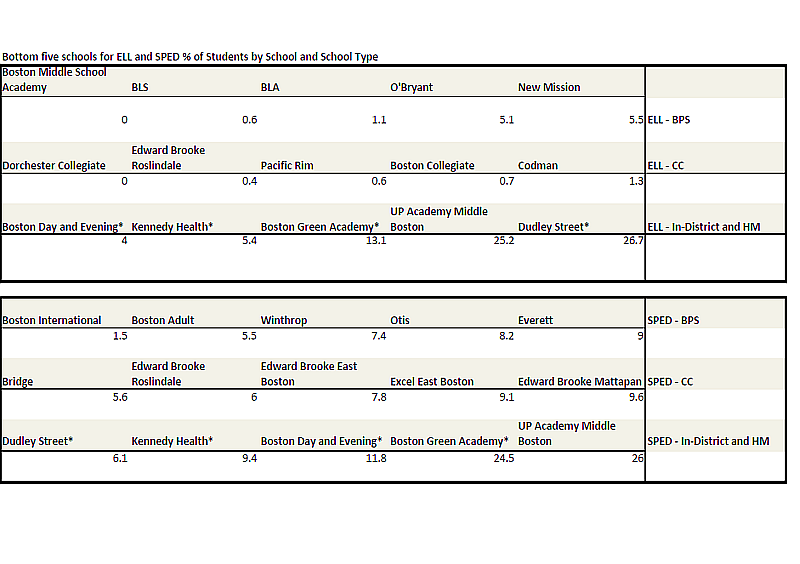
As noted above, charter schools are able to select which students they will educate and multiple sources of information including utilizing the raw data from school profiles on the MADESE site without any interpretation, have and continue to prove that the charter schools claims of serving the same students as BPS does is false. Utilizing the raw data from the MADESE site which has profiles of every "public" school in the state, my friend and I put together a snapshot of the top 5 (who has highest #s) and bottom 5 (who has lowest #s) for each type of school in Boston (BPS, In-District Charter, and Commonwealth Charter schools) based strictly on MADESE data not "selective choice" as some may suggest. There is no interpretation of this data at all, we are just showing the actual numbers themselves for comparison. There is more to come very soon and every school WILL be included!

Our major news media outlets are constantly hyping that charter schools are much better at educating students than the "regular BPS schools", but now you can clearly see that the information they have been stating as "fact" are actually "spin". Hopefully, if you hung in this far, by now you can clearly see for yourself that the pro-charter groups and reporters are spreading misinformation, as there are drastic differences between the types of students who are being served in charter schools versus regular BPS schools which makes a huge difference in comparing who does a better job.

Here are a few other little known facts about charter schools which should be extremely concerning to us all: 
  • Charter schools have a worse graduation/retention rate than our BPS schools do! As it has already been laid out quite well in an article by another blogger in March, until the school by school comparison my friend and I are preparing is finalized, I will direct you to that article: Charter School Attrition.

  • Charter schools have a higher rate of suspension that our BPS schools do, see the article here: Raise the Cap on Traditional Public Schools.

  • Charter schools' "teach to the MCAS" method of educating students does not set the students up well for SATs as proven through MADESE data again: Charter School Achievement Gap. 
Recently, Boston students organized a press conference and rally at the state house which I will write a bit more about in another article, but if you would like to see a brief synopsis of the press conference and rally despite the lack of credit given to those awesome students, please check out this article. This was a student initiated movement, contrary to the title and focus on what the adults had to say. The students of the Youth On Board, Boston Student Advisory Council, and other groups give me great hope for the future, and should not be ignored as they are the true experts on all of this right now because their education depends on them.

I will be writing much more on this topic as the battle, and yes, it is a battle, to save our public schools is heating up. In the meantime, if you would like to read more about the truth behind education "reform", check out some of my favorite bloggers:

Edushyster: Keeping an eye on the corporate education agenda, in Massachusetts and beyond. "Ed" combines facts and wit throughout the articles.

Mommy On the Floor: has just started writing about charter school issues, but has many great articles beyond charter schools!

I would love to connect with those of you who are as concerned as I and others are about the charter school cap being raised, so please contact me via email bpsnightmare@gmail.com or Twitter @bpsnightmare.


Friday, June 7, 2013

1 Data Comparison of BPS vs. Charter Schools SWD, ELL Populations

This is a snapshot of top 5 (who has highest #s) and bottom 5 (who has lowest #s) for each type of school in Boston based on MADESE data not "selective choice", there is no interpretation of the data at all, just showing the actual numbers. There is more to come very soon and every school WILL be included!

Comparison of BPS public schools vs. Boston Charter Schools
Student Populations of Students with Disabilities (SWD) & 
English Language Learners (ELL)

ALL data for these charts came directly from the Massachusetts Department of Elementary & Secondary Education (MADESE) - raw numbers used! http://profiles.doe.mass.edu/

5 Highest schools per each population and school type:


5 Lowest schools per each population and school type:


Thursday, June 6, 2013

0 Say No to Outside Influencing of Our Children's Education through Boston Political Races

Our elections in Boston right now have the potential to lead our city into the same fate as that of Chicago where 49 public schools are closing, if the wrong person is elected Mayor, or those elected as City-Councilor, Senator, etc for that matter. Big corporations, "education reform" organizations and individuals from OUTSIDE our city and state are trying to buy candidates by investing in their campaigns, indirectly funding workers for campaigns, ads, literature and events. Certain candidates are, and have for years, taken what they could from these groups and ignored their own constituents while assuring them they were actually going to work for their best interests. Yes, this happens often, I am far from naive, but it needs to stop.

My dear readers and friends - I am calling on ALL of you to help me help our great city (and our awesome state) by working with me to ensure that our children, ALL of them, do not end up with the same fate as the children of Chicago and other cities! I am asking YOU to take a stand and insist that if a candidate will not sign on to the "People's Pledge for Boston", introduced by Rob Consalvo, which would be a promise by the candidate to keep undisclosed outside special interest money out of the 2013 Boston mayoral (and city council et al) race, that you will not vote for them. 

If you know me, are a friend on Facebook, follow me on Twitter, or drive by my house even, you know who I will be voting for in September! His call to keep outside interest money outside of the election is yet one more reason why I am in Rob's corner along with his promise to ensure all of our children a quality education no matter what their needs are along with the many accomplishments, not just for his district, but across the city. 

The quote below, from the Washington Post, "The Rev. John Thomas: No Act of God Caused Chicago Schools Closings", sums it up for me: 
"They are gone because of decades of very deliberate decisions by public officials, corporate interests and ordinary citizens that have eviscerated the neighborhoods of Chicago, displacing people with the demolition of public housing, gutting communities with foreclosures and the elimination of jobs. The schools are gone because they have been replaced by charter schools, the darlings of politically well-connected school reformers making a profit on tax money while public officials eliminate the inconvenience of teachers unions."
My fear, a valid one given the lurking special interest groups looking to invest big money into the campaign(s) of those who endorse raising the charter school cap, is that Boston IS the next Chicago. My question to YOU is: do you REALLY want to be one of those "ordinary citizens" who sat back and didn't even do something as simple as phone, email, social-media pressuring of candidates - or do you want to live up to your Boston roots (whether born or transplant) of resistance to outside influences dictating our children's future?

Want to know who got paid by whom and what the issue is regarding lifting the charter school cap here in Massachusetts? 

Resources:

Education "Reformers" and the issues:

EduShyster: The Liftin O' the Cap - a great resource on charter schools, reformers et al with a witty writing style, so check out "Ed"'s other articles!

ReThinking Schools: For or Against Children? 

WBUR: Charter School Advocates Eye Investment In Mayor's Race
Be sure to read the comments!

Who got paid:
Save Money. Live Better. Open a Charter and Break the Unions Part I

Save Money. Live Better. Open a Charter and Break the Unions Part 2


I can be contacted at bpsnightmare@gmail.com and please consider following me on Twitter: @bpsnightmare.


Friday, May 3, 2013

0 Boston "School Quality Working Group" Members Announced

On Wednesday, May 1, 2013, the Boston Public Schools' (BPS) School Quality Working Group (SQWG) held their first meeting. This meeting was primarily to announce and introduce the members of the group. The SQWG was created out of the recommendations approved by the Boston School Committee (BSC) as part of the new student assignment plan (Home-Based A) in March 2013. The entire list of recommendations are available here.

According to the BPS bostonschoolquality.org website: 
Boston School Committee member Meg Campbell and Boston University School of Education Dean Dr. Hardin Coleman will co-chair the new School Quality Working Group, which is modeled on the External Advisory Committee on School Choice, which Dr. Coleman also co-chaired. The Working Group includes BPS parents, academic experts, and business and community leaders. It will continue to engage the community in the conversation on school quality that took place during our process to improve school choice. Their tasks include:
  • Helping to develop a better way to measure school quality for the Home-Based school choice model, which takes effect for the fall of 2014. Currently the Home-Based model uses MCAS Tiers, which are based on a combination of overall performance and growth as measured by MCAS.
  • Analyzing the implementation of the Home-Based school choice model, including measures of equity and school quality improvements
The members of the committee are:

Ron Ancrum- Executive Director, The Learning Center at Bromley Heath
Meg Campbell (co-chair) - BSC member, Co-Founder and Executive Director, Codman Academy *Charter Public School
Kathleen Colby -  BPS Ambassador, former BPS parent & EAC member
Hardin Coleman (co-chair) - see above
Michael Curry - President, NAACP Boston Chapter
Rahn Dorsey - Evaluation Director, the Barr Foundation & EAC member
Betty Francisco - EVP and General Counsel of Millenium Sports Club Management, wife of Paul Francisco (EAC member)
Denise Gonsalves - Director of Youth Leadership Development at Dudley Street Neighborhood Initiative (DSNI) 
Dr. William (Bill) Henderson - Former BPS teacher, principal of O'Hearn (now the Henderson) inclusion school, author of The Blind Advantage
Carolyn Kain - Current Chair, BPS SpedPAC & EAC member
Craig Lankhorst - former BPS principal & EAC member
Daniel Linsky - no confirmable information found
Meredith Liu - Chief Financial Officer of Match Charter School
Elaine Ng - Executive Director, Boston Chinatown Neighborhood Center & BPS Parent
Myriam Ortiz - Executive Director, Boston Parent Organizing Network (BPON) & BPS parent
Marchelle Raynor - former Boston School Committee member and Program Director, Gertrude E. Townsend Learning Program
Marinell Rousmaniere -  Vice President of Strategic Initiatives at EdVestors & BPS Parent
Mariah Smith - no confirmable information found
Anh Vu - no confirmable information found
Rev. David Wright - Executive Director of the Black Ministerial Alliance of greater Boston
Josh Weiss - BPS parent who submitted a school assignment proposal to the EAC, took part in many of the EAC meetings as a community member, as well as blogging throughout the school assignment process at bpsworkshop.com

The above information regarding the members are not the official "bios" which BPS has requested from each of the members, but information obtained via prior BPS, EAC, BSC bios, through personal knowledge and relationships and with the help of others who know some of the members and was verified prior to writing this article. Once the official bios are available I will add a link to this post! 

In addition to the above tasks outlined on the new website, the group will most likely have some say in how to address quality issues in our Boston schools. The SQWG group, along with the BSC, holds the future of our students, the individual schools and the district as a whole, in their hands as they are charged with monitoring and assessing the new plan and the recommendations which may become district policies. 

As the families and advocates for our students and schools, we have an even more important role in this process: to monitor and assess the work of both the BSC and SQWG to ensure that all of our schools become quality schools and that access to those schools is equitable. I urge everyone, whether a current or potential BPS family, to follow this group and the work they do. When possible, attend the meetings (still TBA), ask questions, make suggestions and if concerned, let them know that too. 

"Learning is not attained by chance. It must be sought for with ardor and attended to with diligence." —Abigail Adams

I can be contacted at bpsnightmare@gmail.com and please consider following me on Twitter: @bpsnightmare.

Monday, April 15, 2013

0 Boston Strong


A day so bright, sun high, skies clear
Love, laughter, family, friends gathering
Running for charity - the focus of the day
Celebrating the birthplace of America
And honoring those who believe in freedom

Heartbreak Hill meant halfway through
Panic abounds when explosions rock downtown
Marring the perfection of the day
Acts of cowardice and chaos take over
Bringing true heartbreak to the finish line

News spreads quickly, rumors faster
Numbers pour in of injured and dead, fear taking hold
The nation and world feel the shock of this disaster
Disbelief, rage and anger take over
Horror echoes across the social-media stratosphere

As the smoke starts to clear, acts of bravery come to light
A man cradles a victim, people run to help the injured
Donations, offers of shelter, food and assistance to strangers
Outpourings of kindness amidst confusion and pain
As tears continue to flow

No matter who or why, they failed in their mission
Picking the wrong place to attack
Continuing to extend our hands, hearts and hearths
We will rise proudly and punish those who harmed us
The heart and soul we will always stand Boston strong

Copyright Karen Kast 4-15-13


Sunday, April 7, 2013

0 Boston Public Schools New Assignment Plan

The problem with our education system is not that parents do not have a choice. The problem is that inequities continue to exist. -Patsy Mink

We live in the city where public education was created, a city which is considered to be one of the most advanced cities with some of the greatest minds available, and yet, inequities still exist in our public K-12 schools. These inequities harm not only our most vulnerable populations of children, those who are socio-economically challenged and students who may be English Language Learners (ELL) or have a disability (SWD), but all of our students because they all pay the price for these inequities. As the K-12 grades are the foundation for our students future success, it is important that we address the educational issues as quickly as possible. So how do we fix these disparities? 

According to Mayor Menino, Dr. Carol Johnson, and others, the first step to addressing the issues our schools face is by putting in place a new assignment policy which will allow students to go to school closer to home. This push for schools closer to home is what led to the Home-Based model as the proposed assignment model for Boston Public Schools (BPS). On Wednesday night, March 13, the Boston School Committee (BSC) held the last community hearing regarding the proposed assignment model followed by a regular BSC meeting which included a vote on the Home-Based model. 

While the hearing and school committee meeting were going on, a loud protest was taking place outside the building by members of several groups and unions. I only spent a few minutes outside listening to the speakers, but most of us in the Winter Chambers could hear the chants of "Say no to racism in education" and see the signs they pressed against the windows while circling the building!


As there were well over 20 people signed up to speak during the hearing, the BSC meeting rules dictated that the original 3 minutes per person be cut to 2 minutes per person. As you can imagine, the BSC Hearing went over the one-hour time allotted for it and into the regular BSC meeting, with a brief break from testimony to officially start the BSC meeting. BSC Chairman Michael O'Neill allowed the hearing testimony to be directly followed by the "public comment" period of the BSC meeting. 


There were 2 1/2 hours of intense testimony by parents, advocates, community members, and politicians. Many community members testified that the focus should be on the quality of our schools; walk-zone priority being kept or removed; capacity concerns under the new plan; the clear inequity of the new plan for our most at risk students; concerns about our SWD children; concerns about segregation; and, the validity and interpretation of the data used.


Dr. Muriel Leonard, former BPS speech pathologist, principal, deputy superintendent and chair of the task force to identify school quality indicators, testified that as in 2004, once again quality was the issue raised most during the school assignment process and that the recommendations then are primarily the same as those made by the task force in 2004 which were never fulfilled. Dr. Leonard went on to state that the BSC should ensure that all the recommendations of both the 2004 task force and the EAC should now be fulfilled and that she, like others, will not accept "quality later".

Councilor John Connolly was the only politician who testified that the walk-zone priority should be kept, whereas Councilors Tito Jackson and Charles Yancey testified that the walk-zone priority would enhance the inequality of the Home-Based plan and should be removed. All of the Councilors testified that the focus should be quality schools. 


Barbara Fields, former teacher and then Senior Equity Officer for BPS, as well as serving on the executive board of the Black Educators Alliance of Massachusetts (BEAM), testified regarding the work that must be done to address issues of resources and planning, that even with removal of the walk-zone priority the home-based plan still disadvantages students of color and socio-economically challenged students as many of those children live in areas of the city where the schools are designated as the lowest performing schools. Ms. Fields urged the BSC members to ensure that quality remain a focus even after a vote that she was sure would lead to the home-based plan being adopted.

As I had outlined the issues of the "BPS Tiers" vs. actual Massachusetts DESE MCAS level designations during previous testimony, I instead focused my own testimony on highlighting the following:
  • "Access" does not equal actual assignment, it only gives families the choice of certain schools - there is no guarantee your student will get a seat at one of your top choices;
  • Questions still remain regarding:
    • the validity of the data used;
    • the interpretation of said data;
    • policy recommendations and clarifications still needed;
    • issues pertaining to students with disabilities (many);
    • what happened to the requirement to have "academic improvement strategies" for each school being created and publicized prior to implementation of the plan.
  • That further capacity analysis needs to be done:
    • the data used did not factor in students who registered for Kindergarten in Rounds 2, 3, etc or students in grades 1-8, which leaves out a lot of students and though Kindergarten may be where the majority of students enter BPS, it is not the only grade level entry point for new students for many reasons.
    • What about grandfathering of students with disabilities in their current school if they are in a specialized programs that due to the new BPS SWD Overlay map causes their program to be moved to a different school (again)? Will BPS honor the grandfathering of those students at their current school and run concurrent programs in separate schools until the grandfathered students at a school are all out of 8th grade? (this could possibly apply to ELL students also!).
  • The "Quality improvement" promises are based partially on Mayor Menino's legislative proposals. There is no guarantee those proposals will pass at the state level or a guarantee by our city and state politicians or BPS of alternative funds/resources if the proposed legislation fails. This could lead to serious ramifications for the promised "quality improvements". I personally will not accept "well, we didn't get the money, so we will need to delay those improvements" as our political leadership and the district A) should have thought of this anyway, and B) I have been bringing this issue up since October through testimony at BSC, EAC and through articles and conversations - and still there is no alternate plan in place that has been publicized, so none of us should let this go.
When the last community member finished testifying, there was a presentation by the External Advisory Committee on School Assignment (EAC), represented by members Dean Hardin Coleman, EAC Co-Chair, and John Nucci. In addition to the EAC presentation, John McDonough, BPS CFO, acting as Interim Superintendent during Dr. Johnson's bereavement leave, read Dr. Johnson's memo which outlined her recommendation of the Home-Based model without the walk-zone priority. Dr. Johnson's recommendation leaves walk-zone access in place because that access is built-in to the Home-Based model. 

During and after the EAC presentation, the BSC members were able to ask questions about the Home-Based model, and the recommendations by the EAC and Dr. Johnson. I credit the BSC members for asking some great questions. 

John Barros asked that the district come up with a way to create the choice baskets for each family based on actual capacity of open seats at a school, factoring in the number of seats that are already guaranteed to siblings, instead of just based on proximity of the school and Tier designation. Mr. Barros example was of a school which he is given as a choice, but in reality, due to sibling grandfathering, there are actually only 5 open seats available, which ties in directly to scenarios and questions I laid out during my examination of the Quality Choice Plan (QCP) in October and which can now be asked regarding the home-based model. Mr. Barros suggested using the available seat information to then potentially add additional schools to families baskets to allow families a greater chance of obtaining a seat they want for their child.

Caludio Martinez, adding on to a recommendation of amendment to the "recommendation memo" made by Mr. Barros, illustrated the issue of the difference between the BPS "Tier" system and the MADESE "Level" designations. Mr. Martinez stated that while registering his child for school he was given the choice of the JFK school, according to BPS it is a Tier 2 (top 50% of schools), whereas MADESE Level has it listed as a Level 4 (turnaround status) school, which shows that clearly he was not given a true "high quality" school as part of his list.

While responding to Mr. Martinez's observation about BPS Tier vs. MADESE Levels, Dr. Kamalkant Chavda, Asst. Supt for Data & Accountability, stated that because the MADESE way of comparing schools statewide "were not appropriate and significantly different" which significantly penalizes BPS, that BPS decided to come up with a BPS specific metric for assessing the schools. One of the "nuts and bolts" ways of assessing the BPS schools (more favorably obviously) was "that our students with very high needs, students with disabilities and ELL students, Level 1, 2 and 3 were removed from that analysis, because again, by default, we are ranking schools, tier-ing schools and we want to make sure when we do that we remove some students with very high needs who are served in very specialized strands."* For the entire statement by Dr. Chavda on this, please see the video of the meeting and go to the fourth hour (04:26m). * MUCH more on this later as you can imagine! 

However, due to a correction by Alissa Ocasio, BPS Legal Advisor, the "friendly amendment" could not go forward attached to the EAC recommendations or without the Superintendent making her own recommendations first according to state law. Chairman O'Neill did note that Mr. Barros could bring the suggestions up under new businesses which would allow the BSC to ask for the Superintendent and BPS' input and recommendations on same, which is what ultimately ended up happening.

After all the testimony, questions and answers on Wednesday night, March 13, the Boston School Committee (BSC), by a vote of 6-1, approved the Home-Based school assignment plan without the walk-zone priority for Boston Public School (BPS) students. They also approved all of the recommended overlays and recommendations, inclusive of grandfathering of current students and their siblings. 

I fully support a new, less convoluted system for assigning our students to school. I also like close to home for children, especially younger students, and in fact have been lucky that except for my son in high school, my girls have been able to attend schools close to us. 


That said, I am extremely concerned that with this vote done, we will not see the same level of community pressure to ensure that good policies are put in place regarding this new plan and our schools quality levels. We need the community that came out, spoke up and pushed for the focus to be on quality first, even when they get busy with other things, to continue the fight for all of our students and their right to quality schools no matter where they live. Otherwise, I fear we will be back to just a few of us, like Peggy Weisenberg, Barbara Fields, John Mudd, Kim Janey, myself (who I am sure the BSC gets tired of hearing from) and a few new faces like Kenny Jervis, Meghan Doran of Boston Busing and Desegregation Project (BBDP) and a few Quest members continuing the pressure. 

What remains to be seen is whether we move Boston schools in a better direction, or will we now, as in 2004 when some of these same recommendations regarding quality were originally made, fail to follow-through?

I will keep updating you regarding the process and other BPS related issues, so I hope you will keep reading!


You can contact me at bpsnightmare@gmail.com and follow me on twitter @bpsnightmare.

Sunday, March 3, 2013

0 More Answers Needed Regarding Boston School Assignment Proposal

As a frequent attendee at Boston School Committee (BSC) meetings, I am pretty good at figuring out what issues or topics are likely to cause reams of questions and discussion from the BSC members. A new assignment proposal for Boston seemed guaranteed to lead to quite a few questions and discussion, after all, it is a huge shift for the district and has the potential to either become one part of the solution or, potentially create more issues within our school system and a massive flight from the city by families able to do so. Somehow though, despite a deadline dictated primarily by politics instead of the educational welfare of all of our Boston children, there was a lack of questions by the BSC members that was amazing to me. 

Case in point, the February 2010 proposal to create the Roslindale K-8 Pathway, the model for the proposed Middle School Feeder overlay map, which was simply an admissions policy change to the student assignment plan only affecting six elementary schools (roughly 1700 students), garnered many more questions, requests for data and clarification of same, and much more discussion by the school committee members than has been seen so far regarding the current proposal before the BSC, which will impact all of our schools and 57,000+ students. 

This is extremely disheartening, especially since there were no questions by BSC members regarding the validity of the data used throughout the process! The data utilized to create and assess the proposals is in question by many advocates and groups because the data used to assess all of the models is based only on the 2012 Round 1 K2 registration data for new students (no siblings in the system yet) which is 1,659 out of the 4,030 students who applied for a K2 seat and the choice popularity data for 2012-2013. 

Throughout the model and neighborhood analysis report presented to the External Advisory Committee on School Assignment (EAC) on February 20, 2013 are consistent statements regarding the limitations of the data:

Limitations 
  • Sample used for analysis does not fully reflect current makeup of BPS student population. 
  • When broken down, data does not necessarily reflect an entire neighborhood’s access to quality.
Additional Limitations
  • The study population is not necessarily representative of all BPS elementary school students.  Specifically, it under-represents Black students and students eligible for free and reduced lunch compared to the overall BPS enrollment.
  • Because of the low representation of students from specific neighborhoods in the study population, the data may not be reliable in analyzing access to quality.

The above is only a sampling of the "disclaimers" regarding the data utilized throughout this process. Similar disclaimers have been made throughout this process in reports and verbally at EAC and community meetings. By pointing out the limitations of the data used, there is an implied admission that the conclusions made during this process do not account for the majority of our BPS students. 

Maybe I am the only one disturbed by this, but I doubt it and suspect that the majority of people, like myself, are probably shocked that when proposing such a drastic assignment change so few of our students were factored into the discussions, many of whom will clearly be impacted, both by assignment as well as programmatic shifts (for ELL and SWD students especially), even if not new incoming K2 students. 

This will probably lead to questioning why anyone would agree to put a plan in place without further data, analysis and impact projections for our current students and the schools. The fact that the BSC members did not ask questions regarding the above is beyond concerning, because any new plan will impact all of our current elementary/K-8 students who the BSC is currently accountable for and yet it seems the focus has only been on future potential students. There is no doubt we need to make projections for future students new to the system, but why are we dismissing the impact of this new plan on current students and their siblings?

While writing this article, I have come up with several more questions, as follows:

  • Why didn't the EAC ask that an analysis of the proposal be prepared which details the projected impact on the schools and our students currently in grades K2-8, inclusive of those potentially entering during those grades?
  • Though I understand why BPS picked the sub-set of K2 students for choice projections, as current students and their siblings are promised grandfathering, doesn't that lead to many of the same questions I outlined in my series regarding the Quality Choice Plan (QCP), especially regarding the actual ability to fulfill the projected capacity demand (and the promised capacity expansion ideas) for those new students along with the siblings who are grandfathered? (I still foresee many upset parents who are promised close to home seats only to find that a K2 seat is still not available at the school closest to them until grandfathering of current students' siblings is done in a few years.) 
  • With regard to the ELL and SWD overlays, one of my questions at an EAC meeting that was never answered specific to SWD strands which were just shifted two years ago is concerning too:  though we have a map breaking the city into clusters (again), BPS has not provided any clear data or even a draft proposed site list for the cluster-based programs specifically for students with "high incidence" disabilities. This could lead to BPS breaking its promise made to families two years ago that the sub-separate strand shifts would be the last time parents would have to go through such a huge change for their students. At that time, BPS claimed that it wanted to ensure predictability for parents of SWD, especially those for whom change can be even more traumatic than other students. My clients have children in those strands, and though the goal of special education is to have the student who needs a highly specialized program enter a more inclusive program when they have met the goals necessary to do so, because progress for many of those students is minimal compared to the student in regular education (think instead of 1 years progress in 1 years time, some of our most at-risk students are only making 3-6 months of progress instead), some of those same students will potentially be moved out of the school many of them just settled into yet again!
The questions that were asked by the BSC members seemed to primarily focus on the Middle School Feeders (capacity/choice), expansion of K-8 schools, timeline of the reports recommended by EAC, cost savings, clarifying that the ELL/SWD maps are cluster-based, and parent compacting. 

The questions/requests made by BSC members that were more in line with my expectations came from Claudio Martinez who asked for specifics regarding the algorithm that will be used to assign students, John Barros who asked that the information regarding the racial equity analysis be presented as part of one of the upcoming hearings, and Michael O'Neill who asked about the EAC's recommendation to keep a walk-zone priority as part of the plan as well as the cost impact specifically around transportation of grandfathered siblings along with a few other specific recommendations. 

Of note is that the day after the BSC meeting there was a City Council Hearing regarding Councilor Frank Baker's proposal of a hybrid school committee, which could lead to three seats on the BSC becoming elected positions instead of Mayoral appointment.

Dr. Johnson, regarding the EAC recommendations stated:
"There is a sense of an accomplishment with this recommendation, and rightly so – but within the recommendation is a serious warning: That simply implementing its elements and claiming victory will not be enough. As the EAC has told us, we must immediately craft a set of interventions and direct our resources to significantly improve quality in schools across our great city..."

Many of the "watch-dogs", both individuals and groups, will continue to pay close attention to whether the recommendations are followed as promised by Dr. Johnson statement:
"Whether the School Committee votes to accept the EAC recommendation around school choice or not, we believe that many of the quality improvements we have discussed over the last several months must move forward. We are taking the necessary steps now to begin planning for and implementing changes in schools that are not performing well for our students."
Interestingly enough, it was community members who asked the hard questions or urged the BSC to make changes to the plan prior to voting on it. 

Almost every community member who testified urged the BSC to take their time as two community meetings, one of which will be held immediately prior to the March 13th 6:00 p.m. BSC meeting, with the vote scheduled for that same meeting, is not enough time. 

Quite a bit of the community testimony focused on quality and the walk-zone priority issues. Slide 12 of the presentation by the Metropolitan Area Planning Council (MAPC) clearly illustrates the inequity of access to Tier 1 & 2 schools across the city if the walk-zone priority is retained in the Home-Based A model as recommended by the EAC. 

Peggy Weisenberg, a civil rights lawyer and long time BSC attendee, testified that the BSC should eliminate the walk-zone as it only further guarantees that geographically advantaged families will retain higher access to quality schools over families who have no Tier 1 & 2 schools in their walk-zone (as evidenced in my last article's example of 132 Seaver St). In her testimony, "Recommendations for Fairness and Equity", Ms. Weisenberg states that the BSC should "Eliminate structural inequities in the lottery-based assignment system which include:
  •     a place-bias that uses a BPS-constructed walk zone unfairly (i) to add tier 1 school choices to BPS-constructed market baskets for geographically advantaged families; (ii) to advertise through BPS-web-based tool the place-bias, giving the old realtor’s/employer’s wink to non-walk zone families -“DO NOT APPLY HERE”; and then (iii) to assign seats using place-bias to control competition for seats at a given tier 1 school, triply disadvantaging those at a less preferably home base; 
  •  .  a time-bias that unduly advantages families entering the lottery early and disadvantages other families, including later registrants and newcomers to our City"
If you would like the full copy of Ms. Weisenberg's testimony, please contact me at bpsnightmare@gmail.com.

Patricia Kinsella and Megan Wolf, of the citywide parent group Quest (Quality for Every Student), also brought up the inequality that will continue if the walk-zone priority is kept in place. Quest has prepared a position paper which may help you further understand the concerns and some of the issues Quest foresees.

Additional testimony was given by advocate Fran Smith requesting that prior to adopting the proposal, the BSC ask that a Racial Impact Assessment be performed. 

Josh Weiss, BPS parent and someone I count on to help me understand the BPS raw data, testified that more data and analysis is needed regarding the Middle School Feeders as there was none presented throughout the process and that the proposal to convert 6 additional elementary schools into K-8 models, which would eliminate seats at the lower grade levels, is concerning as BPS is currently scrambling to find seats for incoming Kindergarten students for 2013. 

I testified in an attempt to urge the BSC that until a concrete quality metric is finally adopted in December 2014, a clear statement that the BPS Tier system is NOT the same as the DESE Level designations needs to be in place, as I am sure there will be much confusion otherwise. I also pointed out, as in my prior article, that BPS' "Tier" levels seem to almost always be one level above the DESE Level designation and contain Student Growth Percentil (SGP), which BPS has consistently been told should never be used to assess schools or staff. In addition, I asked that when planning for the MSF they please put in place clear assignment procedures as I have spent the past month answering questions pertaining to the Roslindale Pathway assignment into the Irving via phone and emails from countless parents!

John Mudd and Kim Janey, of Mass Advocates for Children (MAC), testified regarding concerns about equity access, clear data analysis regarding the impact on all the students, focusing on quality improvements and a clear concrete list of promises by BPS.

If you would like to see the BSC meeting please check out the video.

Absent from this very important meeting were the faces of our elected Boston officials or their representatives, with the exception of Martha Pierce and Rebecca Frisch for Mayor Menino, which is extremely interesting given it is campaign season and school assignment is a hot topic in Boston. 

If you take nothing else from this article, please remember these things:
  1. The data utilized is not representative of the entire BPS population and may under-represent minority and socio-economically challenged populations;
  2. According to the BPS disclaimers throughout the process, the data may not be reliable in analyzing access to quality; and,
  3. Our BSC members are not asking enough questions about the assignment plan and process.
Once again, I urge you, if you have anything to say about the assignment proposal: 

Attend the public hearing this Thursday, March 7th at 6:00 p.m. which will be held at English High School. If possible, also attend and testify at the March 13th hearing and school committee meeting! 

Call and email the Boston School Committee (BSC) members, Mayor Menino and our elected officials with your feedback prior to the Boston School Committee voting to pass this proposal. A complete list of email addresses for the people listed above is available here.

You can contact me at bpsnightmare@gmail.com and follow me on twitter @bpsnightmare.
 

BPS Education Odyssey Copyright © 2011 - |- Template created by O Pregador - |- Powered by Blogger Templates